
Why people quit AI is a question that comes up constantly. A company discovers it, tries it for a few weeks, gets some interesting results and then… stops. Not because it doesn’t work. But because no one explained the difference between using it well and using it wrong.
The problem is not the technology. It’s the approach.
Why people quit AI: the most common mistake
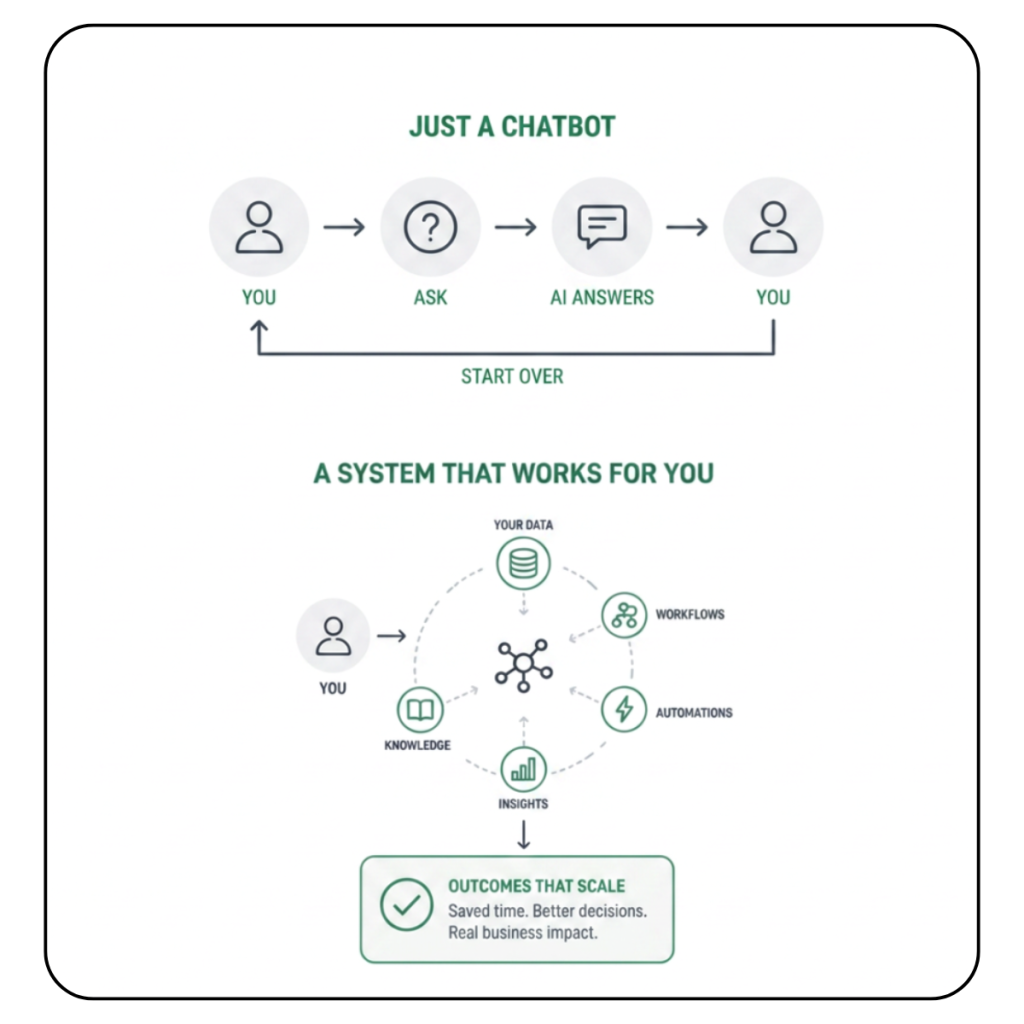
When most people start using AI, they treat it like a very sophisticated search engine. They ask questions. They get answers. They feel satisfied or disappointed. And the next day they start from scratch again.
This model has a name: chatbot. And it has very specific limitations:
- Every conversation starts from zero. No memory, no accumulated context.
- You do all the work: copy, paste, rephrase, repeat.
- Results depend on how you ask, not on how the system is configured.
- It is reactive, not proactive. It responds when you talk to it, but it does not act on its own.
Does it work? Yes. Does it scale? No.
And when something doesn’t scale, it gets abandoned.
Why people quit AI even after seeing results
There is a fundamental difference between using AI and building a system with AI.
An AI system does not wait for you to ask it something. It is integrated into your workflow, has access to your data, knows the context of your business and acts automatically when something requires it.
The difference in practice is enormous:
| Chatbot | System |
|---|---|
| You ask, it answers | It acts when it needs to act |
| No memory between sessions | Accumulated, persistent context |
| Variable results | Consistent, measurable results |
| Depends on how you ask | Depends on how it is built |
| Useful for one-off tasks | Useful for entire processes |
A food wholesaler receiving 800 orders a month via WhatsApp does not need a chatbot to help draft replies. They need a system that reads those messages, interprets them, checks stock levels and enters them directly into the ERP, without anyone touching a keyboard.
That is a system. And that scales.
Why this matters more than ever in 2026
AI is no longer a competitive advantage in itself. It is a tool available to anyone. What makes the difference is how it is integrated into the real operations of each business.
The companies getting concrete results with AI are not necessarily the largest or the most tech-savvy. They are the ones that stopped asking AI questions and started building processes with it.
68% of supply chain companies already use AI to increase operational control, with an average productivity improvement of 22%. But that percentage does not include those who tried it and gave up. It only includes those who made the jump from chatbot to system.
How to know if your company is using AI correctly
Ask yourself this question: would the AI you use today keep working if you were not there?
If the answer is no, you are using a chatbot.
If the answer is yes, you have a system.
There is nothing wrong with starting with a chatbot. But staying there has a real cost: time that is never recovered, errors that keep repeating and an operation that cannot grow without growing the team alongside it.
The starting point is always the same
There is no need to transform the entire company at once. Or to halt operations. Or to hire a team of engineers.
The starting point is identifying the process with the highest volume, the most friction and the highest hidden cost. It is almost always the same: manual data entry of information that already exists somewhere else.
Automate that process first, see results within weeks and scale from there. That is how you build a system. And that is how you stop quitting AI.